通信工具入门
- 最后更新
- 另存为PDF
概况
通信工具介绍
通信工具非常灵活,你可以使用它来管理几乎任何想要在电子邮件之外上报的通信,以便维护在正式的 Procore 记录系统中。
根据我们当前客户的使用方式,以下向你介绍通信工具的用途。
|
|
|
|
|
|

设置
为了开始在项目中使用通信工具,公司管理员必须首先在公司级别创建一个或多个通信类型。
对于没有公司级别管理员权限的人:如果你想开始使用通信工具,请与贵公司的Procore 管理员联系并查看以上列表以获取想法。
管理员步骤:
通信工具不同于 Procore 中的任何其他工具。大多数 Procore 工具适用于特定的业务流程,例如 RFI,并带有关联字段集的预模板,例如所有信息请求都有“任务分配对象”和“截止日期”字段,而通信工具则是供你配置的开放工具。为公司设置新的通信类型时,实际上是在从头开始构建“自定义 Procore 工具”,包括决定哪些数据字段将与其关联。这意味着涉及几个初始设置步骤。
请注意,Procore 为通信类型提供了以下预建模板:
- 附录
- 公告
- 变更请求
- 客户指示
- 约束
- 提早警告通知
- 延期申请
- 一般通信
- 经验教训
- 信函
- 意向书
- 材料请求
- 缓解计划
- 延误通知
- 开工通知
- 扣款通知
- 许可请求
- 项目请求
- 风险识别
- 现场指示
你可以在公司级别管理员工具中查找预建模板。请参阅添加模板通信类型。这些模板帮助你轻松开始使用通信工具 - 然后,当你准备好创建自己的通信类型时,请参考以下步骤。
下面,我们介绍为你的团队设置新通信类型的推荐步骤。你可以为公司创建多种通信类型 - 以下指示将引导你设置一种通信类型。
创建通信类型
需要考虑的事项
- 你为通信类型指定的名称应清楚描述其预期用途(上方列表中显示了一些示例)。类型是项目团队在项目中启动新通信时首先看到的内容,因此请为类型选择一个他们能够识别和理解的名称。
- 建议 - 在通信类型名称中定义一个前缀,以便项目团队可以轻松理解和识别。这便于项目团队在图纸标记中使用或将其链接到其他工具时更容易快速识别通信类型。
- 权限在类型级别应用,并基于模板(通常在公司级别的权限工具中按角色分配)。因此,请考虑谁需要查看和使用此通信类型,并创建单独的类型以适应与不同受众的通信(例如,面向分包商的一般通知和面向业主的一般通知将有所不同)。有关更多信息,请参阅通信:权限。
- 建议- 创建通信类型时选择“默认为私密”。因为通信权限因角色而异,采取此步骤将确保只有特定方(例如特定的分包商)能够看到分配或分发给他们的通信(而不是所有分包商)。(相反,如果通信类型的意图是向特定项目角色的所有成员(例如所有分包商)广播信息,则你应该取消选中“默认为私密”选项。)
- 通信类型也显示在项目主页的项目概况图表上的单独一行中。这样,你可以在每个通信类型中轻松跟踪项状态。
- 如果你的公司正在使用自定义工具(由 Procore 自定义解决方案团队构建),则你不能拥有与自定义工具名称匹配的通信类型。如果你想使用已与自定义工具关联的通信类型,我们建议你更改自定义工具名称。
步骤
- Navigate to the Company level Admin tool.
- Under 'Tool Settings', click Correspondence.
- Click the Types tab.
- Click + Create.
- In the 'Add Correspondence Type' window, select the Make New Custom Type button.
Note: See Add a Template Correspondence Type if you prefer to start from a template or your company's version of the Correspondence tool does not have the option to 'Make a New Custom Type'. - Complete the following information for the new correspondence type:
- Name: Enter a name for the correspondence type.
Tip
Based on the text you enter in the Name field, the system suggests similarly named template correspondence types that have not yet been added to your company's Procore account. You can select the button for a template correspondence type to finish populating the Name field and to automatically populate the Number Prefix field. - Number Prefix (Optional): Enter an alphanumeric prefix (up to 10 characters long) for the correspondence type.
- Optional: Mark the Items are private by default checkbox if you want all items that are created under this correspondence type to be private by default.
- Optional: Mark the Send Email Reminders for Overdue Items checkbox if you want Procore to send automatic email reminders to assignees when an item they are assigned to is overdue. Enabling or disabling this feature affects all projects that use this correspondence type. This is a global feature that cannot be configured for a single project.
- Name: Enter a name for the correspondence type.
- Click Add.
The new correspondence type is created and a banner stating "The template was successfully added." appears. You are then redirected to the 'Edit Fieldset' page for the new correspondence type where you can update the fieldset and apply it to one or more projects (which will allow you to start creating and viewing correspondence items with the new correspondence type on those projects). See Create New Configurable Fieldsets.Tip
- To add or create custom fields to the fieldset for the new correspondence type, see Create New Custom Fields.
- To add custom sections to the fieldset for the new correspondence type, see Create Custom Sections.
创建和应用字段集
需要考虑的事项
- 在此步骤中,你将决定哪些信息(或数据字段)将与此通信类型相关联。你添加的字段将决定项目团队在实际项目中使用此通信类型时将“在野外”收集哪些信息。例如,此通信类型是否需要截止日期、附件字段或记录成本影响的位置?
- 你可以将字段标记为“必填”、“可选”或完全隐藏它们。
- 你可以添加自定义字段,以进一步自定义字段集。
- 你可以为给定的通信类型创建多个不同的字段集,以适应不同项目类型的数据需求变化。
步骤
创建通信类型后,你可以完成创建通信类型的字段集。
更新字段集设置
从下面的第 6 步开始:
- Navigate to the Company level Admin tool.
- Under 'Tool Settings', click the tool you want to create configurable fieldsets for.
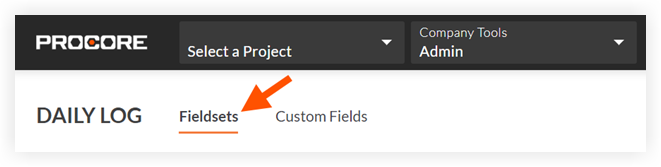
- Click the Fieldsets tab.

Note: Tools without other settings in the Company level Admin tool will open to this page automatically. - Click Create Fieldset and if required, select the fieldset type.
- Enter a name for the fieldset, then click Create.
- On the 'Edit Fieldset' page, each field name has the following options:
- Click the toggle to the ON
position to make the field visible in the section.
OR
Click the toggle to the OFF
position to hide the field in the section.
Note: A
icon indicates that the field is visible by default and cannot be changed to hidden. - Mark the 'Required' checkbox to designate the field as required.
OR
Clear the 'Required' checkbox to designate the field as optional.
Notes:- Fields without a checkbox are optional by default and cannot be changed to required.
- A gray marked checkbox
indicates that the field is required by default and cannot be changed to optional.
- Click the toggle to the ON
- Optional: If available, click Create Section to create a new section. See Create Custom Sections.
- Click Save.
- In the 'Apply changes to [#] project(s)?' window, click Assign Projects to add the fieldset to projects.
- In the 'Assign Projects' window, mark the checkbox next to each project you want to apply the fieldset to and click Update.
- In the 'Apply changes to [#] project(s)?' window, click Confirm.
- Optional: To set a fieldset as the default for new projects, click the
icon at the end of its row on the 'Fieldsets' tab and select Set as New Project Default.
Note
Projects created from a project template that includes fieldsets will inherit the fieldsets from the project template instead of your company's default fieldsets. See Configure a Project Template.
可选:将自定义字段添加到字段集
从下面的第 3 步开始:
- Click the Fieldsets tab.
- Click Edit next to the fieldset you want to add the custom fields to.
OR
Click Create New to create a new fieldset. See Create New Configurable Fieldsets. - Optional: Add the field to a custom section. See Create Custom Sections and What are custom sections and which Procore tools support them?
- Scroll toward the bottom of the page and click Add Custom Field.
- Click Create New.
- Complete the following information for the new field:
- Field Name: Enter a name for the field.
- Field Type: Select the type of field you want to create.
Note: Some field types may not be available for all tools.Expand or Collapse Field Type Options
- Checkbox: The field will be a checkbox that can be marked or cleared.
- Company: The field will be a drop-down menu that allows users to select a Company from the Project Directory.
- Date: The field will allow the user to select a calendar date.
- File Uploads: The field will allow attachments to be added from supported tools in Procore or the user's computer.
- Location: The field will be a drop-down menu that allows users to select an existing location.
- Multi Select: The field will be a drop-down menu that allows users to select multiple values.
- Number: The field will allow a number value to be entered.
Note: When a user enters a number into a 'Number' custom field with no decimal value or with two zeroes after a decimal point, PDF exports with the field will show a decimal value of .0 for the number. For example, if a user enters 123 or 123.00, the PDF export will show the number as 123.0. - Plain Text (Short): The field will be a free text field.
- Project Directory User (Multi Select): The field will be a drop-down menu that allows users to select one or more users from the Project Directory.
- Project Directory User (Single Select): The field will be a drop-down menu that allows users to select a user from the Project Directory.
- Read Only Entry: The field will allow you to type a message, such as instructions, in the text box, which will be visible on an item.
- Rich Text (Long): The field will be a rich text field that supports paragraphs to allow longer responses and bold, italic, and underlined text.
- Single Select (Dropdown): The field will be a drop-down menu that allows users to select one value.
- Tool User (Single Select): The field will be a drop-down menu that allows users to select a user with 'Read Only' or higher permissions to the tool.
- Date / Time: The field will be a combination of a calendar menu and a time of day entry.
- For Multi Select and Single Select field types, complete the following steps to add options:
- Click Add Options.
- Enter the option in the field.
- For each additional option needed, click Add Option and enter the option.
- Click Save Options.
- Click Done.
- Click Create and the field will automatically be added to the bottom of the fieldset.
- Click the toggle to the ON
position to make the custom field visible in the section, or click to the OFF
position to hide the custom field. - If the custom field should be required, mark the 'Required' checkbox. Otherwise, the field will be optional.
- Click Save.
- If the fieldset is already applied to one or more projects, click Apply to Existing.
OR
If you have just created a new fieldset, click Assign Projects and begin at step 3 of the Apply a Fieldset with Custom Fields to Projects section below. - Optional: Click and drag on the reorder grip
icon to rearrange the order that the custom fields will appear on a fieldset.
Note: Procore Standard fields cannot be reordered.
可选:将自定义分项添加到字段集,以组织自定义字段
从下面的第 5 步开始:
- Navigate to the Company level Admin tool.
- Under 'Tool Settings', click the tool you want to create a custom section for.
- Click Fieldsets.
- Click Edit next to the fieldset you want to add a custom section to.
OR
Click Create New to create a new fieldset. See Create New Configurable Fieldsets. - Click +Add Section.
- In the 'Add Section' window, enter a name for the section and click Add.
- To add one or more custom fields to the new custom section, click Add Custom Field under the custom section's name.
- Click Choose from Existing to add an existing custom field.
OR
Click Create New to create and add a new custom field. See Create Custom Fields Within a Fieldset. - Repeat steps 5-8 to add more custom sections.
- Optional: To rearrange custom sections, follow these steps:
- Hover your cursor next to the custom section until the grip icon
displays. - Click on the grip icon and drag the custom section above or below another custom section.
- Hover your cursor next to the custom section until the grip icon
- Optional: To move a custom field to a different custom section, follow these steps:
- Hover your cursor next to the custom field until the grip icon
displays. - Click on the grip icon and drag the custom field above the Add Custom Field button in the custom section you want to move it to.
- Hover your cursor next to the custom field until the grip icon
- Click Save.
完成创建你的字段集并将其应用于项目
-
将一个或多个自定义字段添加到字段集后,点击保存。
- 在“将更改应用于 [#] 个项目?”窗口中:
重要提示
在至少创建一种通信类型并至少为项目应用一种通信类型的字段集之前,项目中不会显示任何通信工具。- 点击应用于现有,对已应用该字段集的项目保存字段集更改。
或者 - 点击分配项目将字段集添加到项目,或从项目中删除字段集。
- 在“分配项目”窗口中,勾选要应用该字段集的各个项目旁边的复选框,然后点击更新。
- 在“将更改应用于 [#] 个项目?”窗口中,点击确认。
- 点击应用于现有,对已应用该字段集的项目保存字段集更改。
- 可选:要将字段集设置为新项目的默认字段,点击
图标位于"字段集"标签页上其行的末尾,并选择设置为新项目默认值。
调整权限
需要考虑的事项
- 通信的权限设置是基于模板的(通常根据角色),并在公司的权限工具中处理。
- 就像任何其他 Procore 工具一样,每个通信类型都有自己的一组权限。权限设置包括无、只读、标准、管理员和细分权限。
步骤
- 导航到公司的权限工具。
- 点击项目权限模板标签页。
- 点击要为其授予细分权限的模板旁边的操作,然后选择编辑模板。
- 滚动到“通信类型和自定义工具”部分。
- 在每个通信类型的行上选择“无”、“只读”、“标准”或“管理员”列中的按钮。
- 点击尖括号 > 图标可打开或关闭每个通信类型的细分权限菜单。
注意:此图标仅在选择只读或标准按钮时显示。 - 勾选“全部开启”复选框以启用对权限模板的所有通信工具的细分权限。
注意:如果启用了所有通信工具的细分权限,则此复选框名称将更改为“全部关闭”。
或者
勾选要在权限模板上启用的每个细分权限的复选框。
Important
Granular permissions for the project's Correspondence tool can be granted for each of your company's correspondence types individually, rather than a tool-wide basis. For information about creating correspondence types, see Create a New Correspondence Type.| Granular Permission Name | Granular Permission Description |
|---|---|
| Create Item | Grants users the privilege to create a correspondence item. Note: Since users with 'Standard' level permissions on a correspondence type can create correspondence items, the 'Create Item' granular permission cannot be unchecked while 'Standard' is selected for the correspondence type on the permissions template. |
| Respond to Items They Are On | Grants users the privilege to respond to correspondence items that they are added to the item's 'Assignee' field, 'Received From' field, or 'Distribution' list. Note: Since users with 'Standard' level permissions on a correspondence type can respond to correspondence items they are on, the 'Respond to Items They Are On' granular permission cannot be unchecked while 'Standard' is selected for the correspondence type on the permissions template. |
|
Edit Open Items They Created
|
Grants users the privilege to edit 'Open' correspondence items that they created. Note: Since users with 'Standard' level permissions on a correspondence type can edit 'Open' correspondence items they created, the 'Edit Open Items They Created' granular permission cannot be unchecked while 'Standard' is selected for the correspondence type on the permissions template. Important: This granular permission is not available for accounts with the 'non-editable" setting turned on at the company level. |
| Respond to Items Accessible to Users within Same Company | Grants users the privilege to respond to correspondence items that are accessible to another user within their same company. Users with this granular permission cannot view 'Private' correspondence items unless they have also been granted the 'View Private Items Accessible to Users within Same Company' granular permission. |
| View Private Items Accessible to Users within Same Company | Grants users the privilege to view 'Private' correspondence items that are accessible to another user within their same company. |
- 点击保存。
配置高级管理员
在项目中配置高级设置
你可以在项目级别为每个通信类型配置其他设置。你可以使用这些设置:
- 为已逾期项启用电子邮件提醒
- 定义默认通讯名单
- 设置自动答复截止日期
- 添加默认描述
步骤
Tab Settings
- Navigate to the project's Correspondence tool.
- Click the Configure Settings
icon and select the correspondence type you want to configure settings for. - Click Tab Settings in the sidebar.
- Complete the following as necessary for your project:
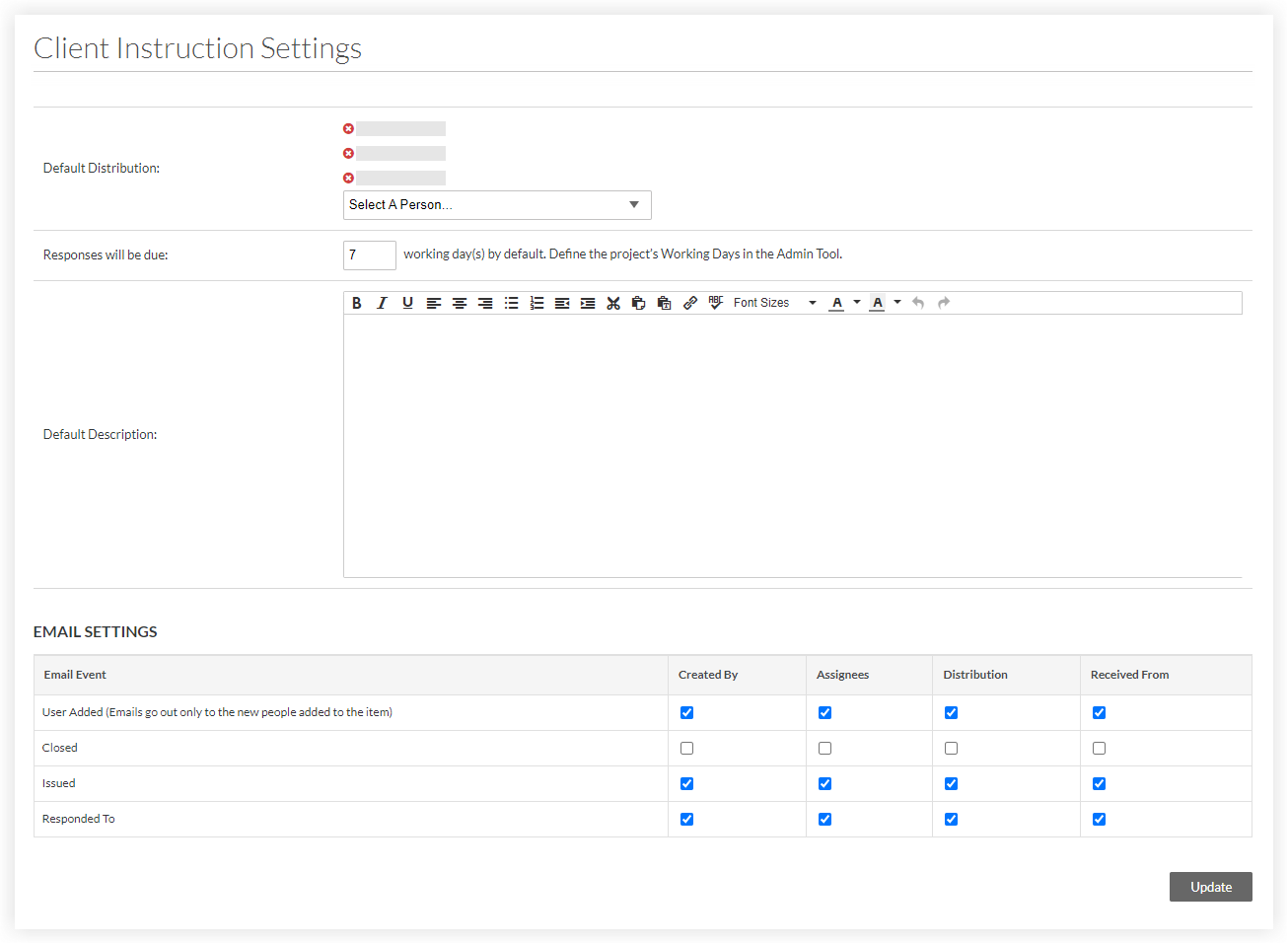
Note: Users who create or edit a correspondence item using this correspondence type can change the Distribution, Due Date, and Description fields for individual items.- Default Distribution: Select one or more users or distribution groups from the drop-down menu. Click the
icon next to a user's name if you want to remove them from this list.
Note: Users must have 'Read Only' level permissions or higher on the correspondence type to be added to this list. See Grant Granular Permissions in a Project Permissions Template. - Responses will be due: Enter a number for the default working days after which a response will be due.
- Default Description: Enter a default description to add to items created using this correspondence type.
- Email Settings: Mark or clear the checkboxes under each user role to determine who will receive the email notifications for each Email Event. See Who receives correspondence item emails and push notifications? for more information.
Note: Some email settings are configured on the Company level and affect all projects. For example, the checkbox 'Send Email Reminders for Overdue Items' is described in Create a New Correspondence Type.Important
If a custom Correspondence self-serve workflow is used on a project, correspondence item email notifications for that project are managed through the workflow configuration settings instead. See What email notifications are sent from workflows?
- Default Distribution: Select one or more users or distribution groups from the drop-down menu. Click the
- Click Update to save your changes.

Permissions Table
- Navigate to the project's Correspondence tool.
- Click the Configure Settings
icon and select the correspondence type you want to view user permissions for. - Click Permissions Table in the sidebar.
The User Permissions table displays for the correspondence type.- The green checkmark
icon indicates the permission level the user has been granted on the correspondence type: 'None', 'Read Only', 'Standard', or 'Admin'. - The red
icon indicates which permission levels are not assigned to the user. - The gray
icon indicates which permission levels are not assigned to the user and cannot currently be changed since the user has been assigned a project permissions template. To change their permissions in the Project level Directory tool, see Change a User's Permissions in the Project Directory.
Tip
See User Permissions Matrix - Web and User Permission Matrix - Mobile for more information about the different actions that can be performed by users with the permission level you select.
- The green checkmark
- To change a user's permission level on the correspondence type when they do not have a project permissions template assigned, click the red
icon for the permission level you want to grant to the user.
The red
icon is replaced with green checkmark
icon and the user's permission level to the correspondence type is automatically saved.
最佳实践
计划
因为通信非常灵活,所以请务必提前制定好全面计划,这样才能确保它能满足你团队的需求。
需要考虑的事项
- 调查内部利益相关方。你可以创建多种通信类型 - 确保你已获得团队的意见,了解哪些类型对他们的项目最关键或最有益。
- 确定合适的流程。对于给定的流程,如果你对以下问题的回答为“是”,则通信可能很合适。
- 这个流程是否基于共享信息和与其他利益相关方沟通?你是否需要利益相关方负责接收或回应这些信息?
- 目前是否通过电子邮件,甚至电话/短信处理此流程?
- 围绕此流程将通信正式化和集中化对你的企业是否有益?
- 如果此流程没有得到恰当跟踪或记录,是否存在时间或金钱损失的风险?
- 你是否有用于此过程的现有模板?
- 你目前是在 Procore 之外还是在 Procore 的自定义工具中完成此流程?
- 是否需要将此流程与 RFI 和变更事件联系起来以进行全面的跟踪和跟进?
- 链接到图纸标记是否会帮助推进此流程?
- 评估全局。制定你的通信类型及其关联数据计划,以确保高效使用通信,避免冗余,并且能符合团队和流程需求。
部署
成功的部署和采用该工具需要团队加入并开始使用新功能。这意味着人员需要了解功能、预期用途以及从哪里寻求帮助和反馈!